
Exploring the histories recorded by Māori land committees and the care taken today to ensure these taonga endure.
Ka mua, ka muri – looking back to look forward
Each year Waitangi Day invites us to pause, look back, and reflect on the history and decisions that continue to shape us today. Among the most significant records informing that reflection are the Papatupu Minute Books – Māori-led committee proceedings that investigated customary land rights in the early 1900s. (1) These volumes, recorded entirely in te reo Māori, are steeped in whakapapa, ahi kaa (continued occupation), and community testimony, forming a vital part of the documentary heritage of Aotearoa New Zealand. Most surviving Papatupu Minute Books relate to Te Taitokerau and are largely held by Te Kooti Whenua Māori – Taitokerau District | Taitokerau Māori Land Court (MLC) with some additional volumes held in other collections, and digital access available. (2) At NZMS, we feel privileged to have played even a small part in supporting this broader kaupapa. Through digitisation, we were able to assist the kaitiakitanga of Te Kooti Whenua Māori and the stewardship of University of Auckland over the copies in their care – helping ensure this historically significant material remains accessible for generations to come.
What the Papatupu Minute Books are and why they matter
The Papatupu Block Committees were established under the Māori Lands Administration Act 1900 to determine ownership of remaining papatupu (customary) lands in six regions, including Te Taitokerau. (3) Between 1902 and 1908, these committees heard evidence from Māori claimants and made recommendations to the Māori Land Councils. The resulting minute books capture detailed records of Māori jurisprudence, decision‑making, and land tenure kaupapa – operating within, yet often standing apart from, the colonial framework. Today, they form an essential body of material drawn on by the Waitangi Tribunal in Te Paparahi o Te Raki (Wai 1040) inquiry, including in the development of the Papatupu Block Committee Minute Book Index (Wai 1040, A54). (4)
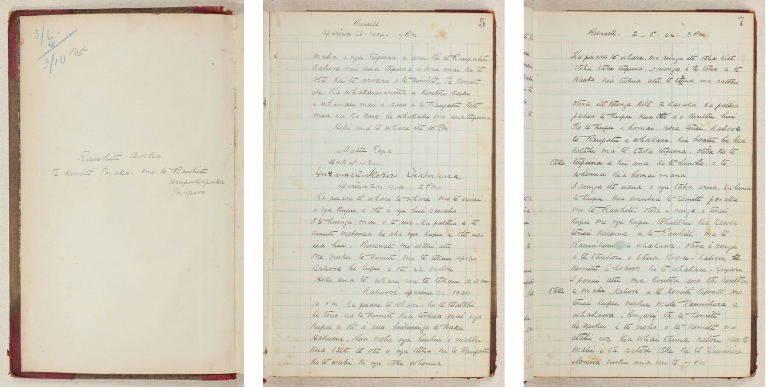
Papatupu Block Committee minute books (Tai Tokerau) /No.18A (Te Rawhiti, Urupukapuka, Te Poroporo), c. 1900–1910.
These records sit alongside the wider collection of Māori Land Court Minute Books, first created under the Native Lands Act 1865 to translate customary ownership into Crown-recognised titles. The significance of this wider collection – now inscribed on UNESCO Memory of the World Aotearoa New Zealand Ngā Mahara o te Ao Register – highlights just how important the Papatupu volumes are within Aotearoa’s documentary heritage. (5) Today, these minute books continue to support whakapapa research, land history, and Treaty scholarship, underscoring their enduring relevance.
Kaitiakitanga in practice: how the work began (NZMS + MLC)
In April 2014, Te Kooti Whenua Māori – Taitokerau District in Whangārei invited NZMS to undertake a pilot digitisation project across several days. Because the books are still active court documents – and many extremely fragile – the Court initially required digitisation to take place onsite so staff could observe our handling practices and ensure tikanga and preservation protocols were followed. The project opened with a mihi whakatau, setting a tone of shared respect and responsibility.
It was important for MLC staff to see our approach first-hand and be confident that NZMS staff were well-trained in handling these taonga. Many of these practices are embedded in archival best practice – no food or liquids anywhere near the capture space; using trolleys to move material; allowing only 2B pencils (no pens or hard leads); removing jewellery and avoiding nail polish; clean, dry hands only; and careful, controlled page‑turning. But our team were also acutely aware of the cultural significance of these volumes, and appreciated the induction and guidance provided by MLC staff when we arrived.
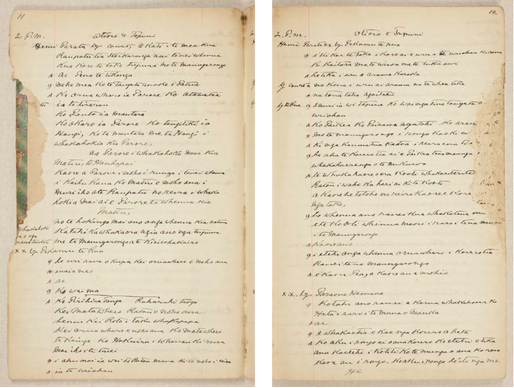
Papatupu Block Committee minute books (Tai Tokerau) / J. Edwards Assessor MB No.2. c. 1900–1910.
Once the pilot was underway, a significant challenge arose with the volume titled J. Edwards Assessor Minute Book No. 2, vol. 2. (6) Severe water damage had left the first seventy or so pages brittle, making the volume particularly vulnerable. To optimise digital image quality, NZMS outlined the benefits of completing digitisation – where it can be done safely – before conservation, as rebinding often prevents volumes from opening fully. After carefully reviewing the risks with MLC staff, digitisation was temporarily paused pending a conservation assessment. Although this slowed the project, it reflects our standard practice: if we have any concerns about the safety of material we’re working on, we stop immediately. Protecting the physical integrity of material is a responsibility we share with its custodians.
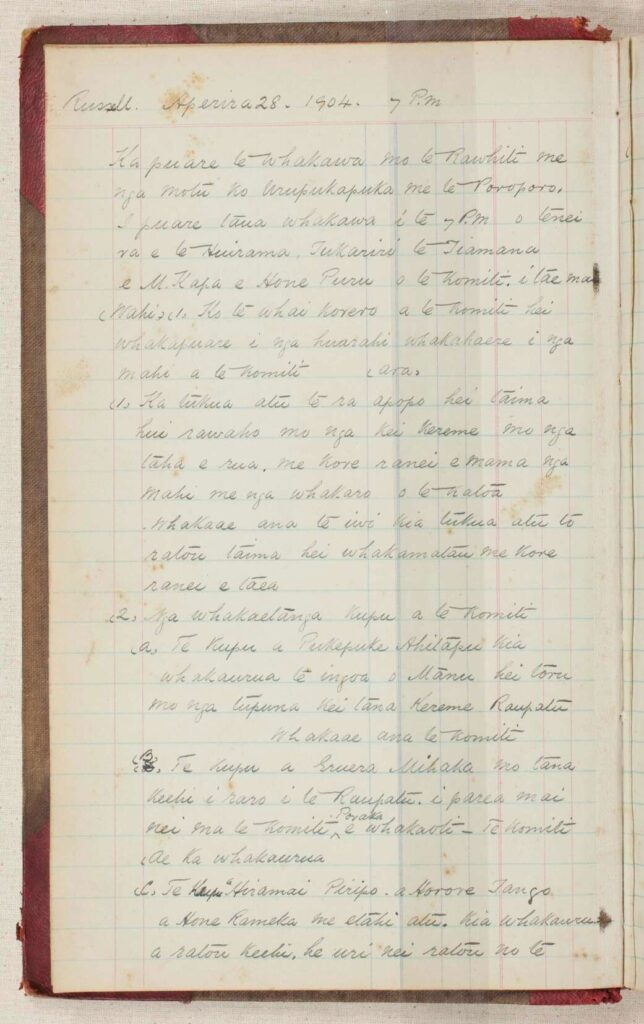
Mylar strip as seen in Papatupu Block Committee minute books (Tai Tokerau) /No.18A (Te Rawhiti, Urupukapuka, Te Poroporo)
Further discussions also focused on how best to achieve reliably flat openings during capture. The format and size of these items ruled out the use of a glass platen on our copy‑stand, normally positioned slightly above the page surface to minimise pressure. Instead, when needed, we used a mylar strip, faintly visible in some images. (7) Following the successful onsite pilot, the Court approved a shift to the NZMS Auckland bureau, where controlled lighting, imaging equipment, and secure storage conditions enabled safe and efficient production.
Originals vs photocopies – why source capture matters
The MLC does not hold a full set of these records. In some cases, photocopies held at the University of Auckland were the only surviving version, the originals having been lost over time. As part of this next phase of the project, NZMS was asked to work directly with the University of Auckland – not only to digitise photocopies where original volumes no longer existed, but also to help determine whether it was worthwhile digitising original copies where access-quality photocopies were available that could be quickly disbound and scanned (thereby saving the originals from removal from Te Taitokerau).
NZMS worked closely with the University of Auckland’s Manager, Māori & Pacific Arts & Humanities, comparing images created from original volumes with their corresponding photocopies. We noticed that the ‘black speckling’ in the photocopies (which sometimes made text less legible) wasn’t evident in the originals. In fact, this visual ‘noise’ was turned out to be discoloured page edges worn by generations of handling. Digitising the originals preserved this nuance, capturing a sense of the books’ physical history that photocopies simply could not convey. As a result, photocopies were digitised only when original volumes were no longer available.
To strengthen trust in the digital surrogates, NZMS and the MLC collaboratively introduced a detailed List of Irregularities for each digitised volume, documenting any missing pages, physical damage, or other anomalies. These lists were intended to reassure legal researchers and whānau that any gaps in the digital sequence reflected the condition of the original material rather than scanning omissions. This approach complemented the use of targets – a practice inherited from microfilming, where a printed card such as “Missing Page” would be photographed in place of an absent leaf to confirm that the omission was deliberate.
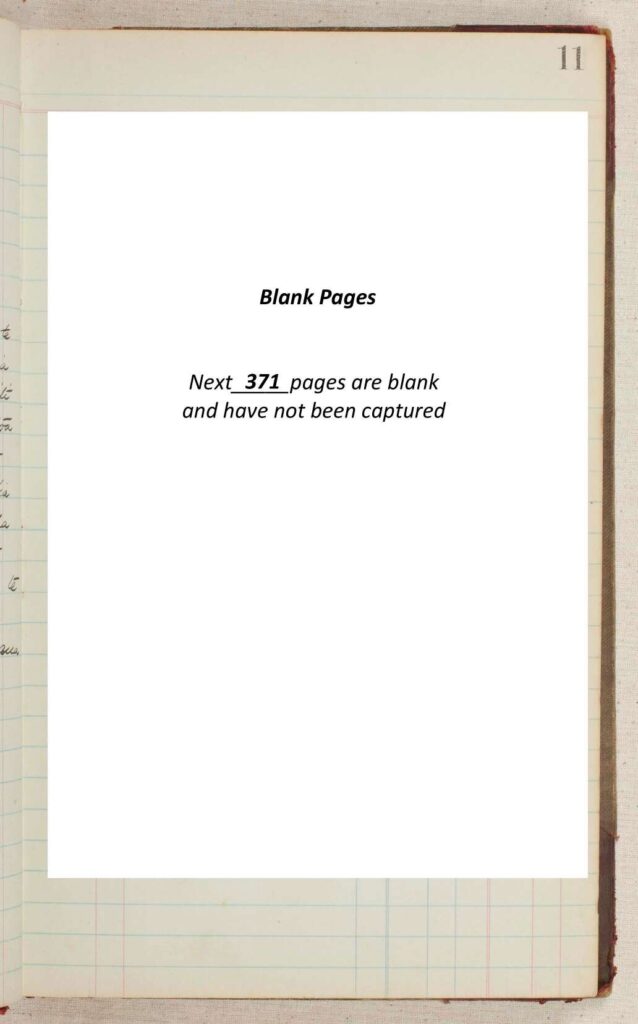
Printed sheet stating “Blank pages not captured” as seen in
Papatupu Block Committee minute books (Tai Tokerau) /No.18A (Te Rawhiti, Urupukapuka, Te Poroporo)
In the context of the Papatupu Minute Books, this method needed to be especially robust and consistent. NZMS operators counted blank pages and inserted precise digital targets, such as: “The following 317 pages are blank and have not been captured.” Normally, NZMS would use a single front-of-volume target stating, for example, “Blank Pages Have Not Been Captured,” but this project required far more granular detail to remove any doubt for legal researchers reviewing these historically and legally important documents.
Consideration was also given to how the digital images would be viewed on screen. Because many researchers work with a two-up, facing-page display to mirror the experience of consulting a bound volume, NZMS operators sometimes captured additional blank pages to ensure the digital sequence accurately reflected the original spreads. This preserved the visual logic of the book – particularly where notes, rulings, or cross-page references spanned both sides – and reduced the risk of misinterpretation when viewing the digital version. One aim of this approach was to create such an accurate and dependable digital surrogate that researchers would not need to request the physical volumes, allowing the originals to remain safely stored. Achieving this required a high level of operator skill, as staff needed to anticipate how the final PDF or digital package would present while capturing each image, ensuring that structural cues in the original volume were faithfully carried through to the digital surrogate.
Access, holdings, and the research ecosystem
The Te Kooti Whenua Māori – Taitokerau District remains the primary custodian of the original Papatupu Minute Books. Additional access points include: University of Auckland Special Collections; University of Waikato’s Māori Land Court minute book holdings the Māori Land Court Minute Books Index; and the Papatupu Block Committee Index (Wai 1040). (8)
The Papatupu Minute Books are more than archival documents; they are living records of Māori leadership, land relationships, and decision-making at a pivotal time in Aotearoa New Zealand’s history. Creating trusted digital surrogates protects fragile originals while widening discovery and access for future generations. (9)
Reference
1 University of Auckland Library. (n.d.). Māori Committee and Land Committee minute books (Tai Tokerau). https://www.archives.library.auckland.ac.nz/repositories/2/resources/337 (accessed February 2, 2026).
2 Auckland Libraries. (2015, July 27). Māori Land Court Minute Books – Part 1. Heritage et Al. https://heritageetal.blogspot.com/2015/07/maori-land-court-minute-books-part-1.html (accessed February 2, 2026).
3 The Papatupu Minute Books are primarily associated with Te Taitokerau as these records form the largest and most intact collection and major research series (e.g.: Wai 1040) centred heavily on the Te Taitokerau Committee material. There are however also surviving Papatupu Minute Books relating toTairāwhiti.
4 Paranihi, J. (2016). Introduction to the Index of Te Taitokerau Papatupu Block Committee Minute Books, 1902–1908 (Wai 1040, A54). Waitangi Tribunal Unit, Ministry of Justice. https://forms.justice.govt.nz/search/Documents/WT/wt_DOC_104342966/Wai%201040,%20A054.pdf (accessed 02/02/2026)
5 Auckland Libraries. Māori Land Court Minute Books – Part 1. (accessed February 2, 2026).
6 Papatupu Block Committee Minute Books (Tai Tokerau). J. Edwards Assessor MB No. 2. https://auckland.primo.exlibrisgroup.com/discovery/delivery/64UAUCK_INST:NEWUI/12419269650002091 (accessed February 2, 2026).
7 University of Auckland Library. (n.d.). Papatupu Block Committee minute books (Tai Tokerau), No. 18A (Te Rawhiti, Urupukapuka, Te Poroporo). https://auckland.primo.exlibrisgroup.com/discovery/delivery/64UAUCK_INST:NEWUI/12419269430002091 (accessed February 2, 2026). Note: page 8 shows mylar strip.
8 University of Auckland Library. (n.d.). Māori Committee and Land Committee minute books (Tai Tokerau). https://www.archives.library.auckland.ac.nz/repositories/2/resources/337 (accessed February 2, 2026); University of Waikato Library. (n.d.). Māori Land Court Minute Books (1865–1975). https://onehera.waikato.ac.nz/nodes/view/9457/ (accessed February 2, 2026); Te Rōpū Whakahau. (2018). Māori Land Court Minute Books Index – Open Access. (accessed February 2, 2026); Paranihi, J. (2016). Papatupu Block Committee Minute Book Index (Wai 1040, A54). (accessed February 2, 2026).
9 Te Rōpū Whakahau. (2018, July 10). Māori Land Court Minute Books Index – Open Access. https://trw.org.nz/2018/07/10/maori-land-court-minute-books-index-open-access/ (accessed February 2, 2026).