The opening of Te Kahu in Wellington marks an important milestone for Aotearoa New Zealand. At a practical level, Te Kahu brings some of the country’s most important memory institutions together in one place – the National Library of New Zealand, Archives New Zealand Te Rua Mahara o te Kāwanatanga, the Alexander Turnbull Library, andNgā Taonga Sound & Vision. It means our documents, films, photographs, sound recordings, and written histories are finally being cared for in a purpose‑built space designed to keep them safe for generations to come.
But Te Kahu also carries a deeper meaning. The name has been gifted by mana whenua iwi and refers to a cloak, expressing the idea of wrapping care, protection, and responsibility around our taonga – our collective memories and histories, rather than simply storing them. Representing te ao Māori / the Māori world view, the name reinforces the role of kaitiakitanga or guardianship at the heart of this work. From a public point of view, this reflects an expansion in how this heritage is accessed. Alongside supporting deep research and specialist use, Te Kahu is designed to welcome people who may be engaging with these collections for the first time – whether for personal, local, or national reasons.
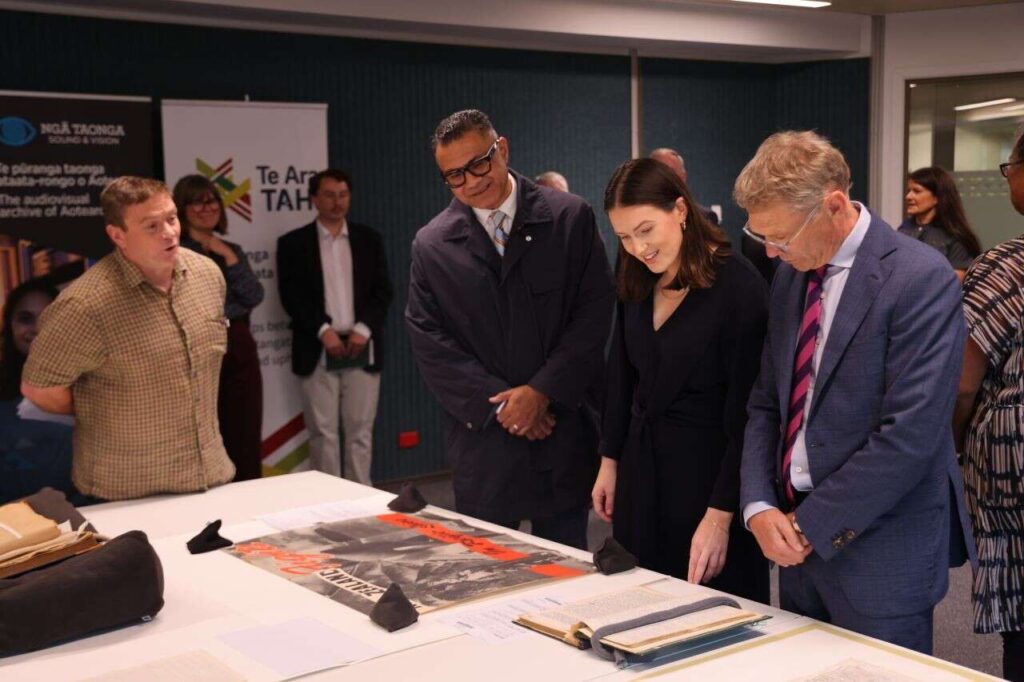
Speaking at the official opening, Minister of Internal Affairs Brooke van Velden highlighted that role, describing Te Kahu as a place intended to keep Aotearoa New Zealand’s taonga accessible “for our children’s children”. It reinforces a long‑term commitment to caring for the nation’s stories.
For those working across the GLAMIR sector – Galleries, Libraries, Archives, Museums, Iwi, and Records – the opening of this new building, interconnected with our National Library, carries particular weight. It reflects a shared responsibility: to care for knowledge with integrity, to uphold trust in information, and to ensure that the stories of Aotearoa New Zealand remain discoverable and accessible across generations.
Partnership in Practice
NZMS was honoured to be invited to attend the opening of Te Kahu, with our founder Andy Fenton alongside colleagues from across the archives and library communities. It was an event that brought together practitioners, leaders, and a good number of our international peers, all connected by a shared commitment to the long‑term care of memory and knowledge.
Commenting on the day, NZMS founder Andy Fenton described it as:
“…a privilege to attend the opening of Te Kahu, a space that reflects how Aotearoa New Zealand preserves the record of government and the breadth of its published and unpublished works for future generations.”
With those international counterparts also in attendance, the occasion carried a broader sense of shared purpose – a reminder that while collections are grounded in place, the principles that guide their care are widely held across the global GLAMIR community.
For NZMS, this moment is both a national milestone and part of a much longer continuum of collaboration with Archives New Zealand Te Rua Mahara o te Kāwanatanga and National Library of New Zealand – grounded in shared standards, trust, and respect for the material itself. Having several team members working on site at Te Kahu is a natural extension of that relationship.
As Project Lead Jared Gibson reflects, the environment is one of genuine partnership:
“It’s a great building to work in, and we are honoured to be on site digitising some of Archives New Zealand’s oldest and most precious material. The Archives Library New Zealand team here have been incredibly welcoming, and we’re working collaboratively as digitisation is re‑established within the broader work programme of the joined-up organisation.”
This work sits at the intersection of preservation and access – safeguarding fragile, irreplaceable records, while enabling wider engagement with the knowledge and stories they hold, now and into the future. Minister van Velden and Te Pouhuaki National Librarian, Rachel Esson, each spoke strongly to this at the opening.
Reflecting on why this work matters
Alongside the opening of Te Kahu, a panel discussion brought together voices from across the archives and library communities to reflect on the work ahead and the context they now sit within.
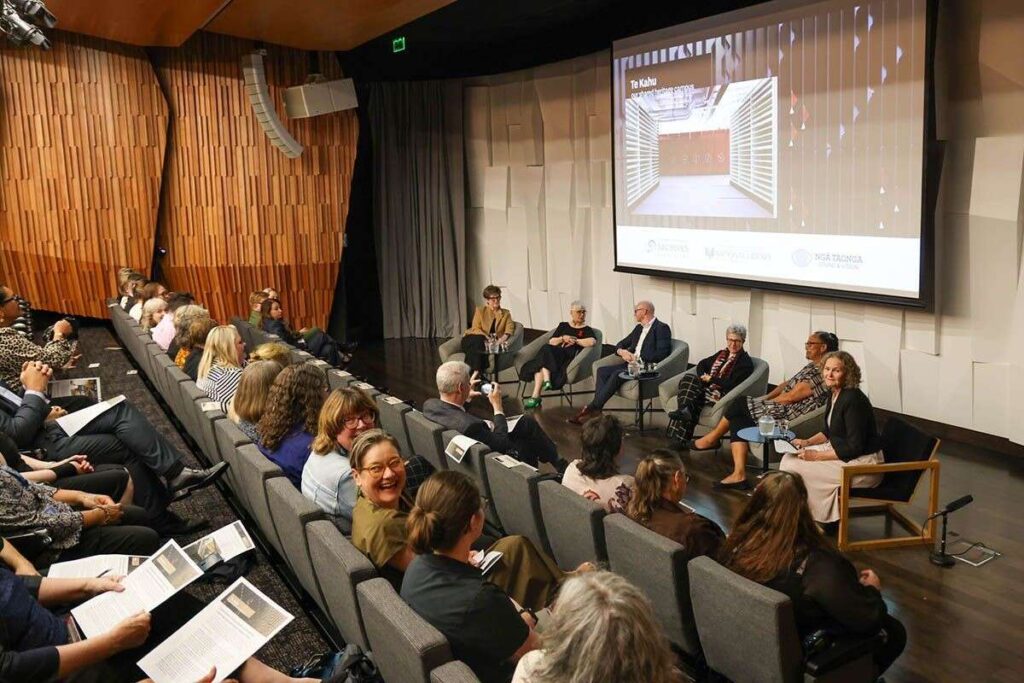
What came through was a shared understanding of the role archives and libraries play as steady points of reference – particularly at a time when information can be contested, misunderstood, or taken out of context. Rather than shaping narratives, their role was described as holding primary sources, preserving evidence, and making it possible for people to explore stories in their full complexity. This was discussed alongside the way media organisations work, where material is necessarily interpreted and framed to meet immediate audiences and contexts.
The discussion consistently returned to people and the different ways individuals and communities engage with collections over time. This included how children are first introduced to their own histories, whether communities can see their experiences accurately reflected in collections, and the ongoing work involved in caring for knowledge across generations, sectors, and cultures. These themes echoed the Minister’s remarks at the opening, where she spoke about work underway to ensure the stories held by these institutions can be more directly connected into schools and learning programmes.
These records exist because people create them, because people take responsibility for their care, and because people return to them – sometimes many years later – seeking understanding, connection, and context. He tangata, he tangata, he tangata – it is people that matter most.
A shared moment
For NZMS, contributing to the work taking place within Te Kahu reflects relationships built over time and the trust that sits behind them. It speaks to long‑term collaboration with organisations that carry significant responsibility for the care of Aotearoa New Zealand’s documentary and audiovisual heritage.
The opening also serves as a moment to recognise the wider community involved in this work. Archivists, librarians, technicians, curators, conservators, and others whose efforts are often unseen, but whose impact is enduring. Te Kahu brings much of that work into view, representing the cumulative effect of many roles working together over decades.
As Wellington’s central library reopens and Te Kahu begins its next phase, long‑planned infrastructure is coming into use across the knowledge and heritage sector. What these projects share is not only investment in buildings, but in the systems, skills, and people required to support community, culture, and memory over time.